
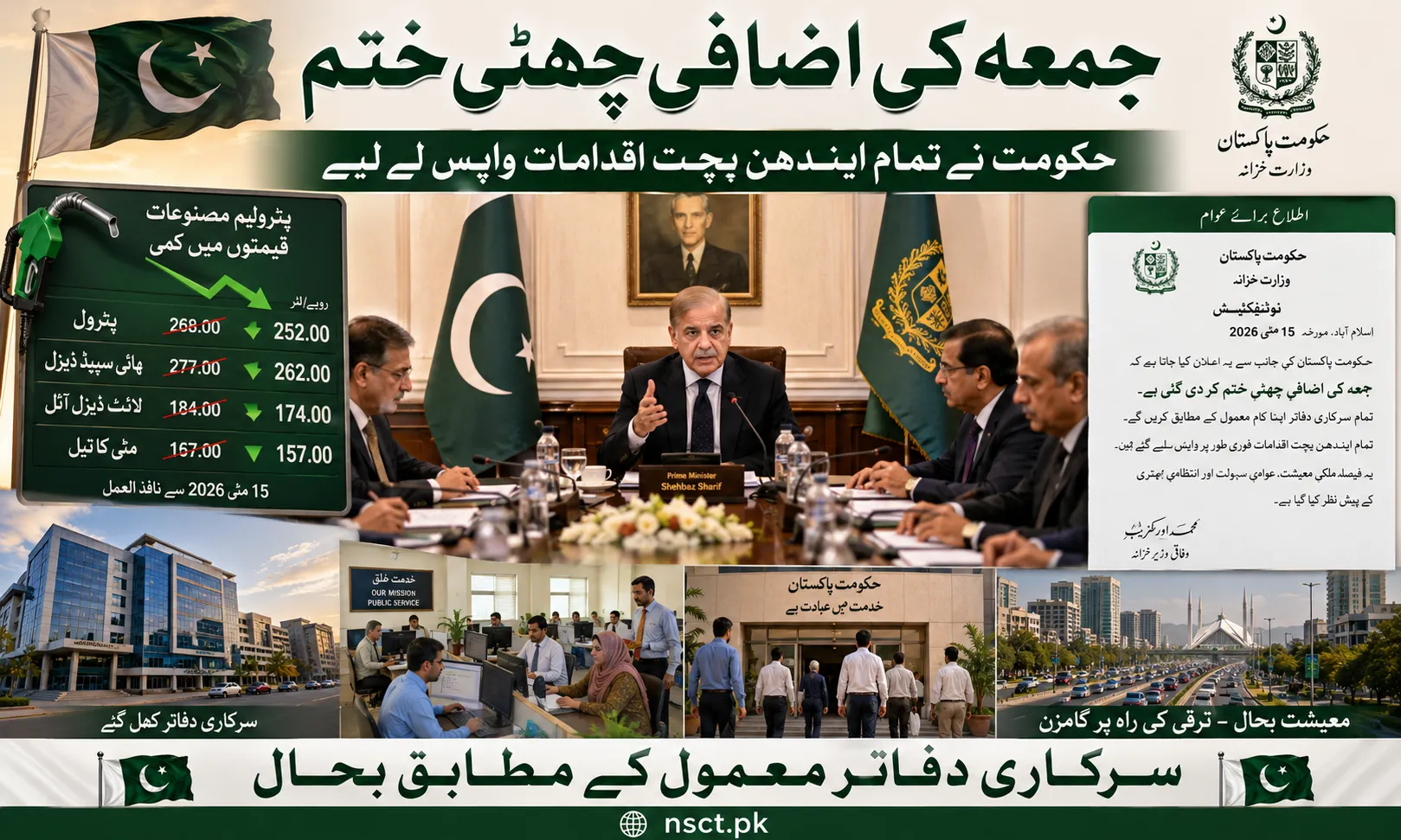
Friday holiday ended in Pakistan after fuel prices dropped and the government withdrew energy conservation measures. Learn about the restoration of the regular work week, fuel quotas, business timings, official policy changes, and their impact on citizens.
The Federal Government of Pakistan has officially ended the temporary Friday holiday and withdrawn several fuel-saving austerity measures introduced earlier in 2026. The decision comes after a significant decline in global oil prices following the de-escalation of tensions between the United States and Iran.
Prime Minister Shehbaz Sharif approved the reversal of emergency energy conservation policies that were implemented to reduce fuel consumption during a period of exceptionally high petroleum prices. With international oil markets stabilizing and domestic fuel prices experiencing substantial reductions, the government has restored the standard work week and resumed normal fuel allocations for government departments and officials.
The latest development marks a major shift in Pakistan’s energy conservation strategy and is expected to impact government operations, businesses, transportation, and the broader economy.

Why Was the Friday Holiday Introduced?
Earlier in March 2026, Pakistan introduced a series of emergency energy-saving measures in response to rapidly increasing global oil prices.
Global Oil Crisis and Rising Fuel Costs
The conflict involving the United States and Iran caused significant disruptions in international oil markets. As a result:
- Global oil prices crossed $100 per barrel.
- Petroleum import costs increased sharply.
- Pakistan faced pressure on foreign exchange reserves.
- Fuel subsidies became more expensive.
To manage the situation, the federal government implemented austerity measures aimed at reducing fuel consumption nationwide.

Emergency Energy Conservation Plan
The government introduced several restrictions including:
- A four-day work week for some departments.
- Additional Friday holidays.
- Reduction in fuel quotas.
- Limited use of official vehicles.
- Early closure of commercial markets.
These measures were designed to lower national fuel consumption and reduce government expenditures.

Friday Holiday Officially Ended
Following the stabilization of global energy markets, the federal government has officially withdrawn the temporary Friday holiday arrangement.
Restoration of the Regular Work Week
Government offices have returned to their normal schedules.
Key changes include:
- Friday is no longer an additional weekly holiday.
- Government employees will follow standard working days.
- Public offices will operate under regular office timings.
- Administrative activities will resume without restrictions.
The move is expected to improve government productivity and public service delivery.
Impact on Government Departments
Federal ministries and government organizations can now:
- Conduct regular operations throughout the week.
- Hold meetings without schedule limitations.
- Improve project execution timelines.
- Enhance public service efficiency.
Fuel-Saving Austerity Measures Withdrawn
The government has also reversed several fuel conservation restrictions.
Government Vehicle Restrictions Removed
Under the previous policy:
- 60% of government vehicles were required to remain off the roads.
- Departments faced strict vehicle usage limitations.
With the latest decision:
- Government vehicles can now operate normally.
- Departments have regained transportation flexibility.
- Field operations and inspections can resume efficiently.
Fuel Quotas Restored
The government has restored fuel allocations that were previously reduced.
Earlier restrictions included:
- 33% reduction in fuel allowances for officials.
- Up to 40% cuts in departmental fuel allocations.
Now:
- Normal fuel quotas have been reinstated.
- Government officials can access standard fuel allocations.
- Operational disruptions caused by fuel restrictions are expected to ease.
Why Did the Government Reverse the Policy?
The primary reason behind the policy reversal is the sharp decline in global fuel prices.
International Oil Markets Stabilized
Several developments contributed to the easing of fuel prices:
- Reduced geopolitical tensions.
- Interim peace agreements.
- Improved energy supply chains.
- Lower crude oil prices.
As a result, Pakistan benefited from reduced import costs and improved energy affordability.
Domestic Fuel Prices Declined
The decline in global oil prices led to:
- Lower petrol prices.
- Reduced diesel costs.
- Improved transportation affordability.
- Reduced inflationary pressure.
These positive developments allowed the government to remove temporary emergency restrictions.
Business Timings Remain Unchanged
Although the Friday holiday has ended, some commercial restrictions remain in place.
Retail Markets and Shopping Malls
According to current regulations:
- Retail shops must close by 9:00 PM.
- Shopping malls must close by 9:00 PM.
The government may review these timings in future policy updates.
Marriage Halls and Marquees
Marriage halls and marquees must:
- Conclude operations by 10:00 PM.
These restrictions continue to support energy conservation objectives.
Restaurants and Cafes
Restaurants and cafes are required to:
- Close by 11:00 PM.
However:
- Takeaway services remain operational.
- Home delivery services are exempt from the restrictions.
Economic Impact of Ending the Friday Holiday
The restoration of the regular work week is expected to bring several economic benefits.
Improved Government Productivity
Government departments can now:
- Process files faster.
- Improve public service delivery.
- Reduce administrative delays.
- Increase operational efficiency.
Better Business Activity
Businesses may benefit through:
- Increased commercial activity.
- More consistent customer flow.
- Improved market confidence.
- Enhanced economic momentum.
Transportation Sector Benefits
The transport sector may also experience:
- Increased mobility.
- Better logistics operations.
- Improved public transportation scheduling.
- Higher business volumes.
What Does This Mean for Citizens?
The end of the Friday holiday affects millions of Pakistanis.
Government Employees
Employees will:
- Return to standard work schedules.
- Follow regular office routines.
- Experience restored operational resources.
Businesses
Business owners can expect:
- Increased weekday activity.
- Better coordination with government departments.
- Improved service accessibility.
General Public
Citizens may benefit from:
- Faster government services.
- Reduced processing delays.
- Easier access to public offices.
Future Outlook
The withdrawal of austerity measures demonstrates the government’s willingness to adjust policies based on changing economic conditions.
Future decisions may depend on:
- Global oil market trends.
- Domestic fuel prices.
- Economic growth indicators.
- Energy demand patterns.
Authorities are expected to continue monitoring fuel markets and may introduce new policies if circumstances change.
Conclusion
The official end of the Friday holiday in Pakistan marks a significant policy shift following the decline in global fuel prices. By withdrawing emergency energy conservation measures, restoring fuel quotas, and resuming the regular work week, the government aims to enhance productivity and support economic recovery.
While commercial market timing restrictions remain in place, the overall easing of austerity measures reflects improved energy market conditions and greater economic stability. Citizens, businesses, and government departments are expected to benefit from the return to normal operations.
FAQs
Why was the Friday holiday introduced in Pakistan?
The Friday holiday was introduced as part of emergency energy conservation measures during a period of exceptionally high global oil prices.
Has the Friday holiday officially ended?
Yes, the federal government has officially withdrawn the temporary Friday holiday and restored the regular work week.
Why did the government end the Friday holiday?
The decision was made after global fuel prices declined and energy markets stabilized following reduced geopolitical tensions.
Have fuel quotas for government officials been restored?
Yes, previous fuel allocation cuts have been withdrawn and normal quotas have been restored.
Are government vehicle restrictions still in place?
No, the restrictions that required 60% of government vehicles to remain off the roads have been removed.
Do business timing restrictions still apply?
Yes, current closing time restrictions for markets, marriage halls, and restaurants remain effective.





1 thought on “Friday Holiday Ended in Pakistan 2026 as Government Withdraws Fuel-Saving Austerity Measures”