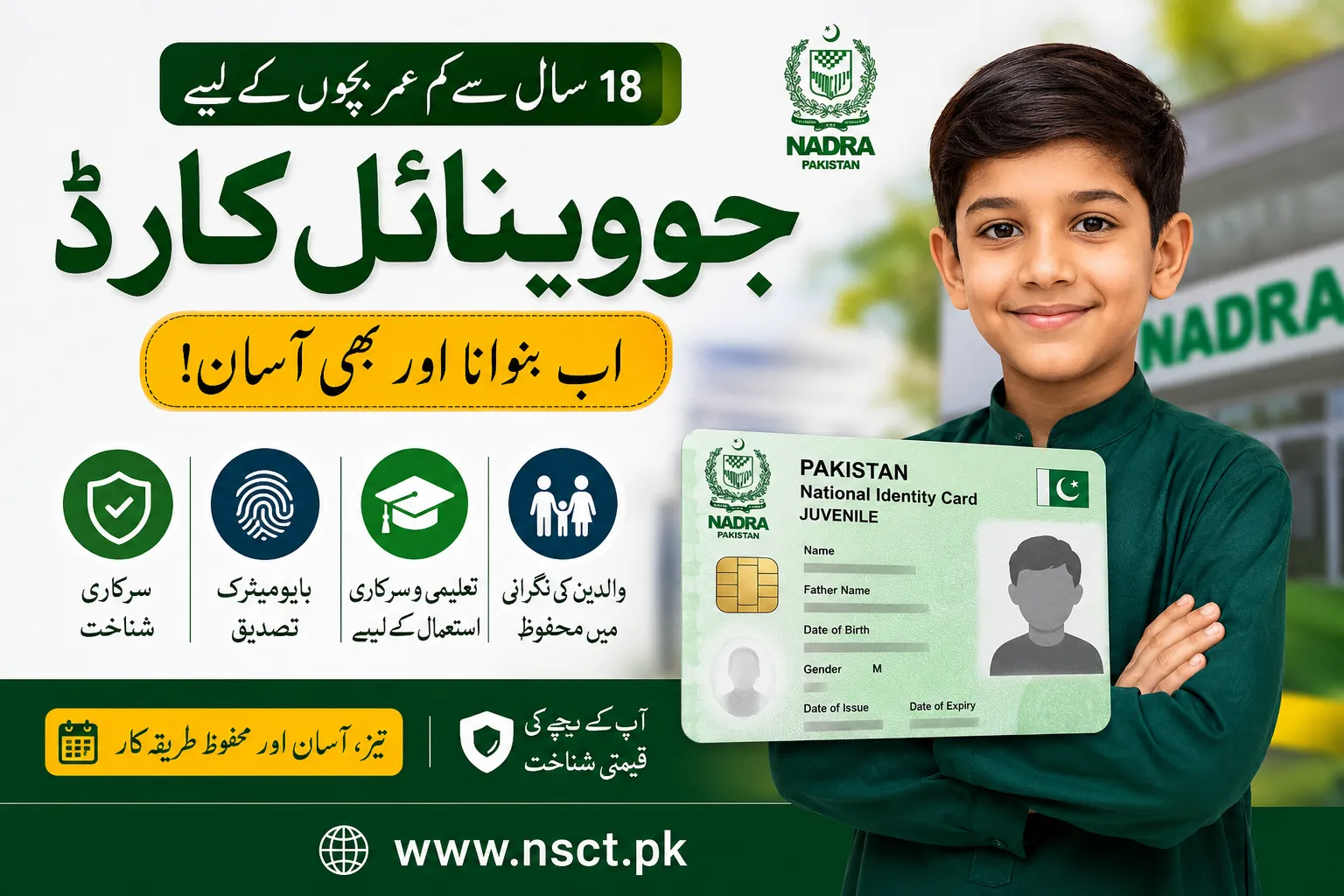
Learn how to apply for a NADRA Juvenile Card for children under 18 in Pakistan. Check eligibility, required documents, application process, fees, biometric requirements, processing time, and FAQs.
Juvenile Card for Children Under 18 in Pakistan 2026: Complete NADRA Guide
If your child is below the age of 18 years, obtaining a NADRA Juvenile Card is one of the most important legal identification steps in Pakistan. The Juvenile Card serves as an official identity document for minors and helps them access many public and private services.
Many parents are unsure about the application process, required documents, biometric verification, fees, and delivery time. This complete guide explains everything in simple English so you can apply without any confusion.
Whether you are applying for the first time or replacing an old card, this article covers the complete procedure according to the latest NADRA guidelines.

What is a NADRA Juvenile Card?
The Juvenile Card (JC) is an identity card issued by the National Database and Registration Authority (NADRA) for Pakistani children who are under 18 years of age.
It provides an official proof of identity and allows the child’s personal record to remain updated in the national database.
Unlike the Computerized National Identity Card (CNIC), the Juvenile Card is specially designed for children and teenagers.

Who Can Apply for a Juvenile Card?
A child is eligible for a Juvenile Card if:
- The applicant is under 18 years of age.
- The child is registered with NADRA.
- The child has a valid B-Form (Child Registration Certificate).
- A parent or legal guardian accompanies the child during the application process.
Benefits of Having a Juvenile Card
The Juvenile Card offers several important benefits.

- Official proof of identity
- Secure biometric registration
- Easier access to educational services
- Helpful for passport applications
- Required for many government services
- Better protection against identity fraud
- Updated digital record with NADRA
As children grow older, having a Juvenile Card also makes it easier to convert to a regular CNIC after turning 18.
Documents Required for Juvenile Card
Before visiting a NADRA Registration Center, prepare the following documents.
Required Documents
- Original B-Form (CRC)
- Parent’s original CNIC
- Child’s physical presence
- Legal guardian documents (if applicable)
If the child is under the care of a legal guardian, supporting legal documents may also be required.
Complete NADRA Juvenile Card Application Process
Below is the complete application process explained step by step.
Step 1: Visit a NADRA Registration Center
Visit your nearest NADRA Registration Center with your child.
The child’s father, mother, or legal guardian must accompany the applicant.
Carry all original documents.
Step 2: Obtain a Token
After reaching the center, collect your application token from the reception.
The token number will determine your turn for processing.
Step 3: Biometric Verification and Fingerprints
When your token number is called, proceed to the assigned counter.
According to NADRA’s procedure:
- Children aged 10 years or above will provide fingerprints.
- Their photograph will also be captured.
- Biometric verification will be completed where applicable.
The officer will verify the child’s information in the NADRA database.
Step 4: Parent or Guardian Biometric Verification
The child’s father, mother, or legal guardian will provide biometric verification.
This step confirms the relationship with the child and helps prevent identity fraud.
The parent must carry an original CNIC.
Step 5: Data Entry
A NADRA official will enter all applicant details into the system.
These include:
- Child’s full name
- Date of birth
- Parent information
- Address
- Other identification details
Carefully review all information before proceeding.
Step 6: Photograph and Signature Verification
The operator will capture the child’s photograph.
Where applicable, signatures or thumb impressions will also be verified according to NADRA procedures.
Always check the displayed information carefully before confirming the application.
Step 7: Pay the Required Fee
After completing the application, pay the applicable fee.
NADRA currently offers three service categories.
| Service | Fee | Delivery Time |
|---|---|---|
| Normal | Rs. 750 | 31 Days |
| Urgent | Rs. 1,500 | 23 Days |
| Executive | Rs. 2,500 | 7 Days |
Choose the category according to your urgency.
Step 8: Collect Your Juvenile Card
After your application is processed, visit the designated NADRA office on the given date to collect your Juvenile Card.
Bring the receipt issued during submission.
Important Instructions from NADRA
Parents should remember these important points.
- The child must personally visit the NADRA office.
- Father, mother, or legal guardian must accompany the child.
- Children aged 10 years or older may be required to provide fingerprints.
- Biometric verification of the parent or guardian is mandatory.
- Review all information carefully before final submission.
- Keep your application receipt until the card is received.
Juvenile Card Fee Structure
NADRA provides three different processing options.
Normal Service
- Fee: Rs. 750
- Delivery: Approximately 31 working days
Urgent Service
- Fee: Rs. 1,500
- Delivery: Approximately 23 working days
Executive Service
- Fee: Rs. 2,500
- Delivery: Approximately 7 working days
Processing time may vary depending on workload and verification requirements.
Are you looking for a call centre Job? Its worth reading article for you https://nsct.pk/meezan-bank-call-center-officer-batch-2026-jobs/
Why Does NADRA Require Biometrics?
Biometric verification improves security and prevents identity misuse.
It helps NADRA:
- Verify family relationships
- Prevent duplicate registrations
- Protect children’s identity
- Maintain accurate national records
- Improve digital identity management
Can You Apply Online?
Currently, the complete Juvenile Card application process requires visiting a NADRA Registration Center because biometric verification and photograph capture must be completed physically.
Parents should avoid unofficial websites claiming to issue Juvenile Cards online.
Always use official NADRA services.
Common Reasons for Application Delay
Your Juvenile Card application may take longer if:
- Documents are incomplete.
- Parent’s biometric verification fails.
- Child’s information does not match NADRA records.
- Additional verification is required.
- Public holidays increase processing time.
Providing accurate information helps avoid unnecessary delays.
Tips Before Visiting NADRA
To make your visit easier:
- Carry all original documents.
- Reach early to avoid long queues.
- Ensure the child’s information is correct.
- Keep your mobile number active.
- Preserve your application receipt.
- Verify spellings before submission.
Difference Between B-Form and Juvenile Card
Many parents think both documents are the same, but they serve different purposes.
| B-Form | Juvenile Card |
|---|---|
| Child Registration Certificate | Identity Card for children |
| Used for registration | Used as official identity |
| Contains family record | Contains biometric identity where applicable |
| Issued after birth registration | Issued after completing NADRA application |
Both documents are important and complement each other.
When Should You Apply?
Parents should apply as soon as the child becomes eligible and has a valid B-Form.
Having a Juvenile Card early can make future applications for passports, educational admissions, and other government services much easier.
Official NADRA Contact
For official information or assistance:
- Website: https://www.nadra.gov.pk
- Helpline: 1777
Always rely on official NADRA sources for updates regarding fees, requirements, and policies.
Frequently Asked Questions (FAQs)
What is the age limit for a Juvenile Card?
A Juvenile Card is issued to Pakistani citizens who are under 18 years of age.
Is the child required to visit the NADRA office?
Yes. The child must be physically present for photograph capture and other verification requirements.
Can a parent apply without the child?
No. The child must accompany the parent or legal guardian during the application process.
Is biometric verification mandatory?
Yes. The parent or legal guardian must complete biometric verification. Children aged 10 years or above may also provide fingerprints according to NADRA procedures.
What is the fee for a Juvenile Card?
Current fees are:
- Normal: Rs. 750
- Urgent: Rs. 1,500
- Executive: Rs. 2,500
How many days does it take to receive the card?
Delivery times are approximately:
- Normal: 31 days
- Urgent: 23 days
- Executive: 7 days
Can I apply online?
No. Physical appearance at a NADRA Registration Center is currently required for biometric verification and photograph capture.
What documents are required?
You generally need:
- Child’s B-Form
- Parent’s original CNIC
- Child’s physical presence
- Guardian documents (if applicable)
Can a legal guardian apply?
Yes. A legal guardian may apply if valid legal documentation is provided and biometric verification is completed.
What happens when the child turns 18?
After reaching 18 years of age, the individual becomes eligible to apply for a Computerized National Identity Card (CNIC).
Final Words
A NADRA Juvenile Card is an important identity document for every Pakistani child under the age of 18. It helps establish an official identity, improves access to government and educational services, and keeps the child’s records secure in the national database.
Parents should prepare all required documents, visit the nearest NADRA Registration Center with the child, complete biometric verification, pay the applicable fee, and collect the card on the given delivery date. Following the official procedure carefully can help avoid delays and ensure a smooth application experience.
By applying early, families can save time in the future when the child needs a passport, educational admissions, or eventually transitions to a regular CNIC after turning 18.