
Islamabad vehicle token tax is set to increase following the Budget 2026-27 approval. Check the latest token tax rates for vehicles up to 1000cc, 1300cc, 1500cc, 2000cc, 2500cc and above, understand how the revised taxation may affect vehicle owners, and learn everything about the proposed changes.
Vehicle owners in Islamabad may soon have to pay significantly higher annual token taxes following the approval of the Budget 2026-27. According to the available information, the revised token tax structure introduces a combination of fixed charges and invoice value-based taxation depending on the engine capacity of the vehicle.
The proposed increase is aimed at updating the taxation system for privately owned vehicles registered in Islamabad. Smaller vehicles up to 1000cc would be charged a fixed annual amount, while higher engine capacity vehicles would be taxed as a percentage of their invoice value.
The revised tax structure has generated considerable discussion among car owners, automobile dealers, and industry experts because it changes how annual token tax is calculated for many vehicle categories.

If implemented as outlined, owners of mid-sized and luxury vehicles could experience higher annual tax liabilities compared to previous years.
Why Is Islamabad Vehicle Token Tax Increasing?
Governments periodically revise vehicle taxation policies to generate public revenue and align taxation with changing vehicle prices and economic conditions.
Under the proposed Budget 2026-27 measures, Islamabad’s vehicle taxation framework appears to shift toward a more value-based approach instead of relying entirely on fixed annual rates.

This means owners of more expensive vehicles may pay higher annual taxes because the tax would depend on the original invoice value of the vehicle rather than only its engine capacity.
Such taxation methods are commonly adopted to create a progressive tax structure where higher-value assets contribute relatively more revenue.

Proposed New Islamabad Vehicle Token Tax Rates
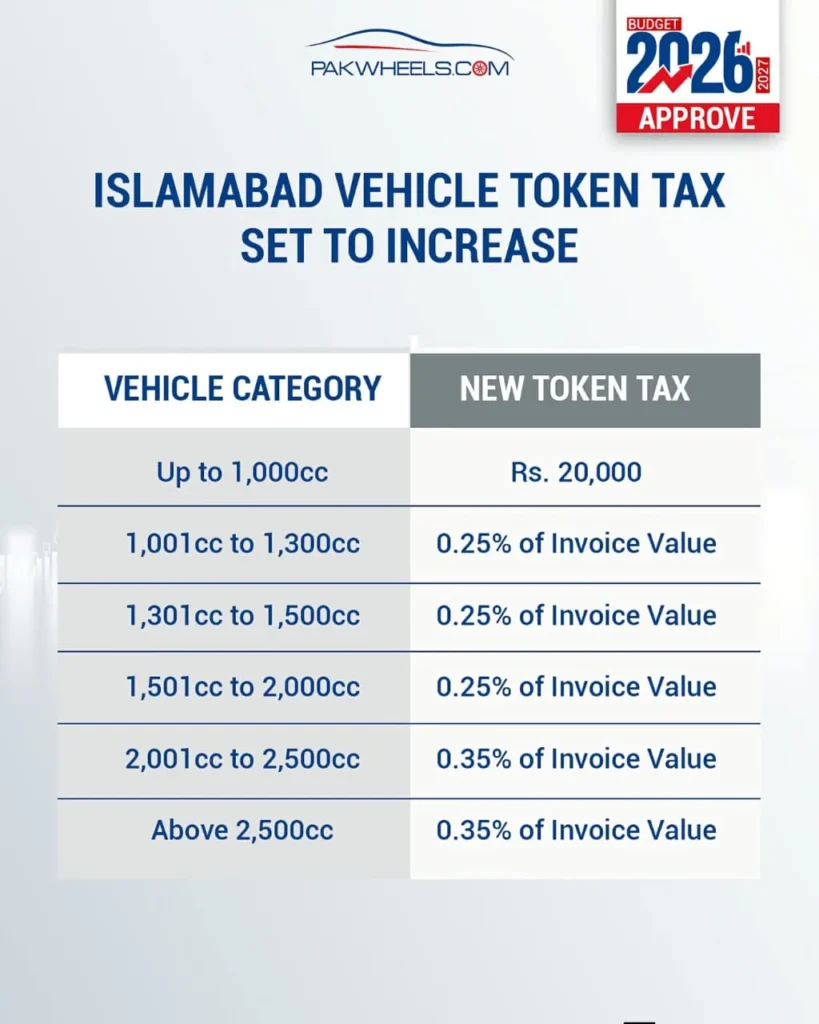
The available information outlines the following revised token tax structure.
| Vehicle Category | Proposed Token Tax |
|---|---|
| Up to 1000cc | Rs. 20,000 |
| 1001cc – 1300cc | 0.25% of Invoice Value |
| 1301cc – 1500cc | 0.25% of Invoice Value |
| 1501cc – 2000cc | 0.25% of Invoice Value |
| 2001cc – 2500cc | 0.35% of Invoice Value |
| Above 2500cc | 0.35% of Invoice Value |
This revised structure indicates that taxation gradually increases for larger and more expensive vehicles.
Understanding the New Token Tax Structure
One of the biggest changes is that taxation for many vehicles will no longer rely solely on engine displacement.
Instead, vehicles above 1000cc may be taxed according to their invoice value.
For example, if a vehicle originally had an invoice price of Rs. 8,000,000 and falls within a category taxed at 0.25%, the annual token tax would be calculated based on that percentage.
Similarly, vehicles above 2000cc may fall under the 0.35% rate.
This approach links annual taxation directly with vehicle value.
What Is Invoice Value?
Invoice value generally refers to the official purchase price of a vehicle when it was sold by the manufacturer or authorized importer.
Instead of charging every vehicle within a specific engine category the same amount, taxation based on invoice value allows higher-priced vehicles to contribute proportionately more.
This system is commonly used where governments wish to create a fairer taxation mechanism based on the value of an asset.
Vehicles Up to 1000cc
Owners of smaller vehicles may see their annual token tax fixed at Rs. 20,000.
Popular vehicles within this category often include compact hatchbacks and entry-level family cars.
Although the tax is fixed instead of percentage-based, many vehicle owners may compare it with previous years to determine whether their annual cost has increased.
Vehicles Between 1001cc and 2000cc
Vehicles ranging from 1001cc to 2000cc are proposed to be taxed at 0.25% of invoice value.
This category includes many of Pakistan’s most commonly used sedans, crossovers, and family vehicles.
Examples generally include vehicles with engine sizes around:
- 1200cc
- 1300cc
- 1500cc
- 1600cc
- 1800cc
- 2000cc
Because taxation depends upon invoice value, two vehicles with similar engine capacities but different original prices could pay different annual token taxes.
Vehicles Above 2000cc
Luxury vehicles, SUVs, premium sedans, and larger crossovers may fall into the higher taxation bracket.
The proposed rate of 0.35% of invoice value applies to:
- 2001cc–2500cc
- Above 2500cc
This means owners of premium imported vehicles and luxury SUVs could experience noticeably higher annual token tax obligations.
Impact on Car Owners
If these revised rates are implemented, vehicle owners may need to allocate a larger annual budget for registration-related expenses.
For many people, token tax is already an essential recurring expense alongside:
- Fuel
- Insurance
- Maintenance
- Vehicle repairs
- Periodic servicing
An increase in annual taxation could therefore raise the overall cost of vehicle ownership.
Owners planning to purchase new vehicles may also begin considering annual taxation before making their buying decisions.
Possible Effect on the Automobile Market
Changes in vehicle taxation often influence buyer behavior.
When annual ownership costs increase, some buyers may shift toward:
- Smaller engine vehicles
- Hybrid vehicles
- Fuel-efficient models
- Lower-priced vehicles
Luxury vehicle buyers, on the other hand, may calculate total ownership costs more carefully before purchasing high-value vehicles.
Dealers may also experience temporary fluctuations in customer demand while buyers evaluate the revised tax structure.
How the New Tax Structure May Influence Buying Decisions
Many consumers focus primarily on the purchase price of a vehicle.
However, annual ownership expenses play an equally important role.
These expenses include:
- Token tax
- Insurance
- Registration
- Fuel consumption
- Routine maintenance
- Spare parts
- Depreciation
If annual token taxes increase substantially, buyers may begin comparing lifetime ownership costs rather than simply selecting vehicles based on engine size or appearance.
For example, a buyer considering a larger SUV may instead choose a smaller crossover if the difference in annual taxation becomes significant.
Economic Perspective
Vehicle taxation serves as an important source of public revenue.
Governments often revise taxation policies to:
- Increase revenue collection
- Modernize taxation systems
- Align tax rates with current market values
- Encourage responsible vehicle ownership
At the same time, policymakers must balance revenue generation with affordability for ordinary vehicle owners.
Changes in taxation therefore receive close attention from consumers and the automobile industry alike.
What Vehicle Owners Should Do
Although the revised tax structure has attracted considerable attention, vehicle owners should stay informed regarding future implementation procedures and official payment instructions.
Practical steps include:
- Keeping vehicle registration documents updated.
- Monitoring official announcements regarding token tax payment schedules.
- Maintaining records of the original vehicle invoice where applicable.
- Planning annual vehicle expenses in advance.
- Following updates from relevant government authorities.
Preparing early can help vehicle owners avoid unnecessary delays or inconvenience when annual token tax becomes due.
Frequently Asked Questions (FAQs)
Is Islamabad vehicle token tax increasing?
According to the available Budget 2026–27 information, Islamabad vehicle token tax is proposed to increase under the revised taxation structure.
What is the new token tax for vehicles up to 1000cc?
The proposed annual token tax for vehicles up to 1000cc is Rs. 20,000.
How will vehicles above 1000cc be taxed?
The available information indicates that vehicles above 1000cc may be taxed as a percentage of their invoice value.
What is the proposed tax rate for vehicles between 1001cc and 2000cc?
The proposed rate is 0.25% of the invoice value.
What is the proposed tax rate for vehicles above 2000cc?
The proposed rate is 0.35% of the invoice value.
What does invoice value mean?
Invoice value generally refers to the original purchase price of the vehicle as recorded at the time of sale.
Will luxury vehicles pay more token tax?
Under the proposed structure, higher-value vehicles may pay more because taxation is linked to invoice value.
Why has the token tax been revised?
The proposed revision appears to modernize the taxation system and align annual taxes more closely with vehicle values.
Does this affect all vehicle owners?
The available information categorizes token tax according to engine capacity, with different rates applying to different vehicle groups.
Should vehicle owners monitor further updates?
Yes. Vehicle owners should continue following official announcements regarding implementation procedures and payment requirements.
Conclusion
The proposed Islamabad Vehicle Token Tax Set to Increase under Budget 2026–27 represents an important development for vehicle owners across the federal capital. Based on the available information, the revised structure combines a fixed annual token tax for vehicles up to 1000cc with invoice value-based taxation for higher engine capacity vehicles.
If implemented, these changes could increase annual ownership costs for many motorists, particularly those owning mid-range, premium, and luxury vehicles. At the same time, the revised approach reflects a shift toward value-based taxation, where higher-priced vehicles contribute proportionately more in annual taxes.
Whether you already own a vehicle or are planning to purchase one in the future, understanding the proposed token tax structure is essential for effective financial planning. Vehicle owners should continue monitoring official announcements regarding implementation, payment procedures, and any further revisions related to Islamabad’s vehicle taxation policy.