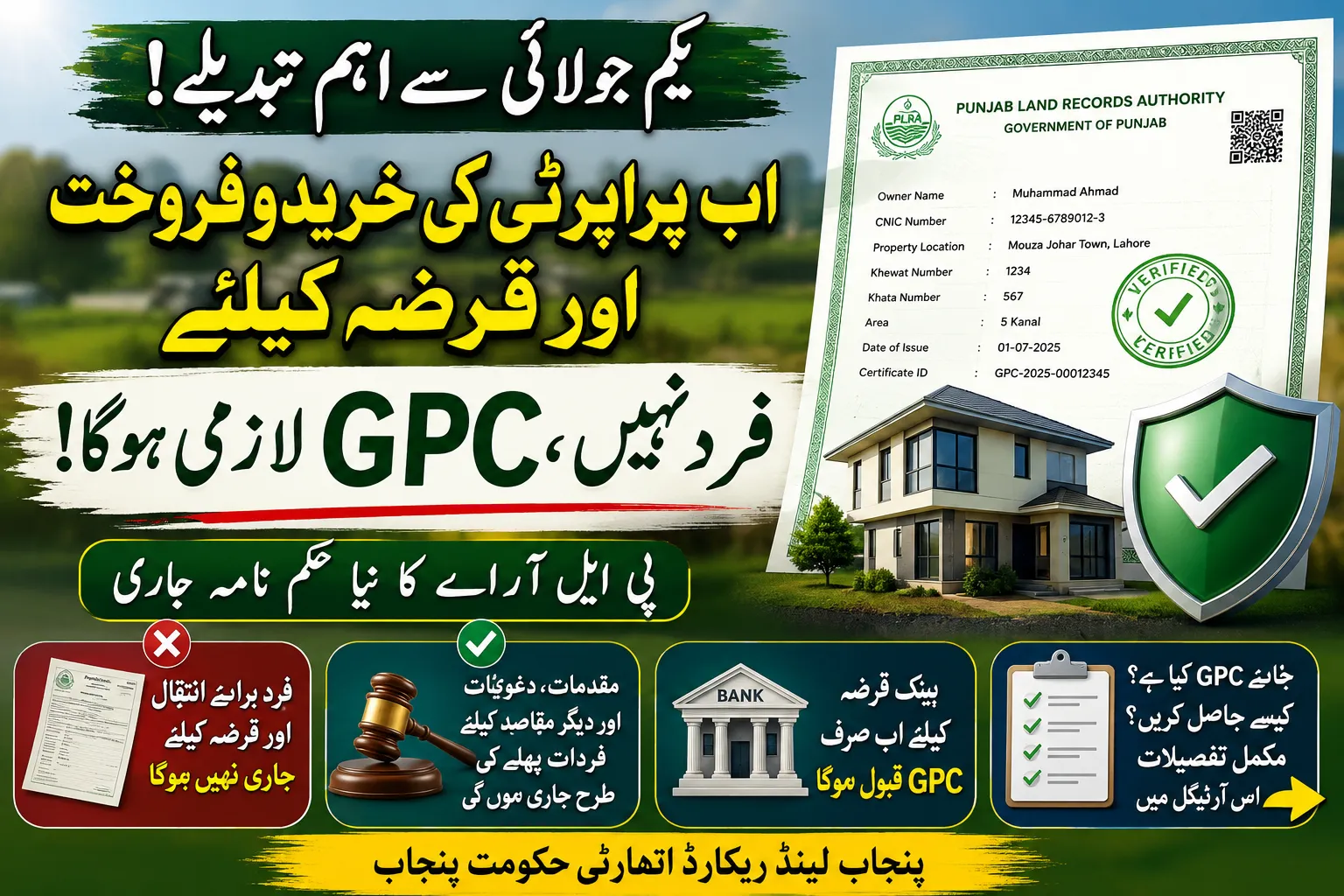
Punjab Land Records Authority (PLRA) has introduced the Green Property Certificate (GPC) for property sale and loan purposes from July 1. Learn what has changed, where Fard is still available, who needs GPC, and how to get it.
The Punjab Land Records Authority (PLRA) has introduced an important change in the way property documents are issued in Punjab. Many people recently saw social media posts claiming that all types of Fard (property ownership certificates) have been completely banned after July 1. This created confusion among property owners, buyers, sellers, banks, and real estate agents.
However, the actual update is different.
The Punjab Land Records Authority has clarified that not every type of Fard has been discontinued. Instead, only specific Fards that were previously used for property transfer (Intiqal) and bank loan purposes are no longer being issued. These have been replaced by the Green Property Certificate (GPC).

This article explains everything in simple English, including what has changed, why the Green Property Certificate was introduced, who needs it, and where the traditional Fard is still available.
What Is the Green Property Certificate (GPC)?
The Green Property Certificate (GPC) is a newly introduced digital property document issued by the Punjab Land Records Authority.
It is designed to make property transactions safer, faster, and more transparent. The certificate contains verified land ownership details and modern security features that reduce the chances of fraud and document tampering.

Instead of using the traditional Fard for certain official purposes, citizens will now use the Green Property Certificate.
The main goal is to improve confidence in Punjab’s land record system and support secure property transactions.

What Changed After July 1?
From July 1, the Punjab Land Records Authority stopped issuing traditional Fard for the following purposes:
- Property transfer (Intiqal)
- Property sale and purchase
- Obtaining bank loans using property
For these purposes, applicants must now obtain a Green Property Certificate (GPC).
This means the traditional Fard is no longer accepted for these specific transactions.
Is Every Type of Fard Banned?
No.
This is the biggest misunderstanding spreading on social media.
The Punjab Land Records Authority has clearly explained that only certain categories of Fard have been replaced.
Many other types of Fard are still being issued as before.
Therefore, people should not believe rumors claiming that all Fard documents have been discontinued.
Types of Fard That Are Still Available
Traditional Fard continues to be issued for several legal and administrative purposes.
These include:
- Fard for litigation and court cases
- Fard for legal claims
- Record verification
- Government departmental requirements
- Other official purposes allowed under existing rules
Citizens who need these documents can continue applying through Punjab Land Record Centers.
Why Was the Green Property Certificate Introduced?
Punjab has been working to modernize its land record management system.
The Green Property Certificate is part of this digital transformation.
Some important objectives include:
Better Security
The certificate contains advanced verification features that make it difficult to create fake documents.
Reduced Property Fraud
Fake ownership documents have caused many legal disputes in the past.
Using a secure digital certificate helps reduce fraudulent property transactions.
Faster Verification
Banks, buyers, and government departments can verify property information more efficiently.
Increased Transparency
Verified digital records improve trust between buyers and sellers.
Modern Digital Land Records
Punjab is gradually moving towards fully digital land management services.
What Is the Difference Between Fard and Green Property Certificate?
| Traditional Fard | Green Property Certificate |
|---|---|
| Used for many property purposes | Used for sale, transfer, and loans |
| Traditional document | Modern digital certificate |
| Limited security features | Enhanced security and verification |
| Previously used for bank loans | Now mandatory for bank loans |
| Previously used for property transfer | Now replaced by GPC for transfers |
Who Needs a Green Property Certificate?
You should obtain a Green Property Certificate if you are:
- Selling your property
- Buying property
- Applying for a bank loan using property
- Completing property transfer
- Registering ownership after purchase
- Participating in property transactions requiring updated land verification
Who Does Not Need GPC?
You may still use the traditional Fard if you need documents for:
- Court proceedings
- Legal disputes
- Property record verification
- Government office requirements
- Other approved administrative purposes
Always confirm the required document before submitting your application.
Benefits of the Green Property Certificate
The new certificate offers several advantages.
Improved Document Security
Digital verification helps prevent forged property documents.
Greater Buyer Confidence
Buyers can trust that ownership information is verified through official land records.
Easier Banking Process
Banks receive standardized property documents for loan processing.
Better Record Management
Electronic records reduce manual paperwork.
Lower Risk of Fraud
Secure certificates help reduce illegal property transactions.
Modern Public Service
Citizens receive more efficient land record services.
How to Get a Green Property Certificate
Although procedures may change over time, the general process includes the following steps.
Visit a Punjab Land Record Center
Go to your nearest Land Record Center.
Provide Property Details
Submit your property information and ownership details.
Identity Verification
Present your original CNIC and any required supporting documents.
Fee Payment
Pay the applicable government fee.
Certificate Issuance
After successful verification, the Green Property Certificate will be issued.
Documents You May Need
Applicants may be asked to provide:
- Original CNIC
- Property details
- Ownership information
- Previous land records if required
- Supporting legal documents where applicable
Requirements may vary depending on the nature of the transaction.
How Does GPC Help Property Buyers?
Buying property is one of the biggest financial decisions people make.
The Green Property Certificate provides buyers with greater confidence because ownership details are verified through official digital records.
This reduces uncertainty during property transactions.
How Does GPC Help Banks?
Banks require reliable ownership verification before approving loans.
The Green Property Certificate provides a standardized and secure document that makes verification easier.
This helps banks process applications more efficiently while reducing the risk of fraudulent property claims.
Impact on Real Estate Market
The introduction of GPC is expected to improve the overall property market.
Some expected benefits include:
- Increased transparency
- Better investor confidence
- Reduced fake property documents
- Faster verification
- Improved digital governance
- Stronger land record management
These improvements can make Punjab’s property sector more reliable over time.
Common Misunderstandings
Many people misunderstood the July 1 announcement.
Here are the facts.
Myth: Every type of Fard has been discontinued.
Fact: Only Fard used for property transfer and loan purposes has been replaced.
Myth: People cannot obtain any Fard now.
Fact: Several categories of Fard continue to be issued.
Myth: Existing land ownership has changed.
Fact: The update only changes the type of document used for certain transactions. Property ownership itself remains unchanged.
Myth: Court-related Fard has also been stopped.
Fact: Fard for litigation and other legal purposes continues to be available.
Tips Before Buying Property
To protect yourself during any property transaction:
- Verify ownership through official land records.
- Use only authorized Land Record Centers.
- Confirm whether GPC is required.
- Never rely only on photocopied documents.
- Verify seller identity.
- Keep copies of all official documents.
- Consult a legal expert for high-value property transactions.
Frequently Asked Questions (FAQs)
What is the Green Property Certificate?
It is a secure digital property certificate issued by the Punjab Land Records Authority for property sale, transfer, and loan purposes.
Has every type of Fard been banned?
No. Only Fard used for property transfer and obtaining loans has been replaced.
Can I still get Fard for court cases?
Yes. Fard for litigation, legal claims, record verification, and several other official purposes is still available.
Is GPC mandatory for property sale?
Yes. For applicable property sale and transfer transactions, the Green Property Certificate replaces the traditional Fard.
Is GPC required for bank loans?
Yes. Applicants seeking loans against property are now required to use the Green Property Certificate where applicable.
Where can I obtain the Green Property Certificate?
You can apply through Punjab Land Record Centers following the official procedures announced by the Punjab Land Records Authority.
Does this change affect existing ownership?
No. It only changes the document required for specific transactions.
Final Thoughts
The introduction of the Green Property Certificate (GPC) marks another step toward the modernization of Punjab’s land record system. Despite rumors circulating online, the traditional Fard has not been completely discontinued. Instead, it has been replaced only for property sale, transfer, and bank loan purposes, while other categories of Fard remain available for legal and administrative needs.
If you are planning to buy, sell, transfer property, or apply for a loan against your property, it is important to understand these new requirements and obtain the correct document. Always rely on information issued by the Punjab Land Records Authority (PLRA) and avoid acting on unverified social media claims.
By adopting secure digital documents like the Green Property Certificate, Punjab aims to improve transparency, strengthen property security, reduce fraud, and make land transactions easier for citizen.