

Learn everything about the new regulatory duty rates on imported cars announced in Pakistan’s Budget 2026-27. Discover revised duty rates for hybrid and ICE vehicles, expected price changes, market impact, and what the Finance Act 2026-27 means for car buyers.
Introduction
The Government of Pakistan has introduced significant changes to the regulatory duty on imported vehicles under the Budget 2026-27, bringing welcome relief for car buyers and automobile importers. According to the approved Finance Act 2026-27, regulatory duty has been reduced on several categories of imported vehicles, particularly hybrid and internal combustion engine (ICE) vehicles with engine capacities above 1300cc.
The reduction in regulatory duty is expected to improve the availability of imported vehicles, lower overall import costs, and encourage greater competition in Pakistan’s automotive sector. It may also influence vehicle prices, particularly in the premium SUV and hybrid segments, while providing consumers with more purchasing options.
This article explains the revised regulatory duty rates, compares them with the previous tax structure, discusses their potential impact on car prices, and highlights what buyers should know before purchasing imported vehicles.

Budget 2026-27 Regulatory Duty Changes at a Glance
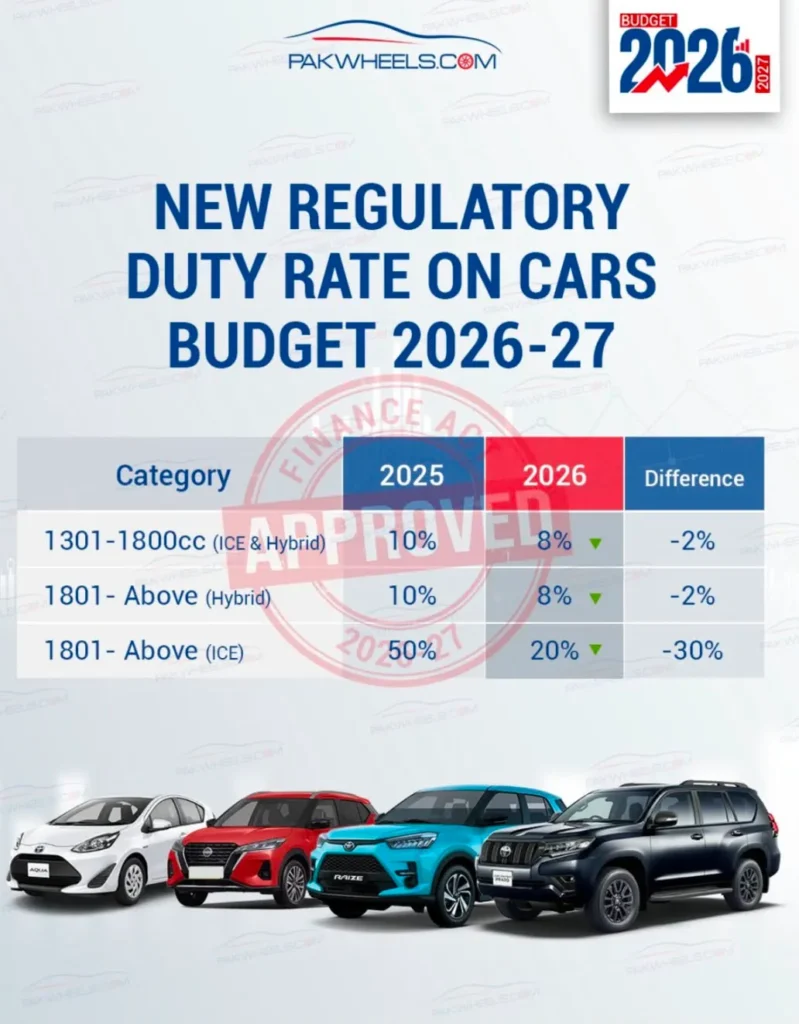
The Finance Act 2026-27 revises regulatory duty rates for imported vehicles in three major engine categories.
| Vehicle Category | Regulatory Duty 2025 | Regulatory Duty 2026 | Difference |
|---|---|---|---|
| 1301cc–1800cc (ICE & Hybrid) | 10% | 8% | -2% |
| Above 1800cc (Hybrid) | 10% | 8% | -2% |
| Above 1800cc (ICE) | 50% | 20% | -30% |
The most notable reduction applies to imported ICE vehicles above 1800cc, where the regulatory duty has been reduced by 30 percentage points, representing one of the largest changes announced for the automobile sector in the current budget.
Understanding Regulatory Duty
Regulatory duty is an additional tax imposed by the government on imported goods beyond normal customs duties and other applicable taxes. In Pakistan, regulatory duty is often used to:

- Control imports
- Protect local industries
- Manage foreign exchange reserves
- Influence consumer demand
- Encourage domestic manufacturing
Changes in regulatory duty directly affect the cost of importing vehicles, making it an important factor in determining final showroom prices.
Vehicle Categories Included in the New Rates
The revised regulatory duty applies to different categories of imported passenger vehicles.

1301cc to 1800cc Vehicles
This category includes many popular imported sedans, crossovers, and hybrid vehicles commonly purchased by Pakistani consumers.
Examples include:
- Toyota Corolla Hybrid
- Toyota Prius
- Honda Vezel
- Honda Civic Hybrid
- Toyota C-HR
- Kia Niro
The regulatory duty has been reduced from 10% to 8%, offering modest relief to importers and buyers.
Hybrid Vehicles Above 1800cc
Hybrid SUVs and luxury vehicles with engines above 1800cc have also received a reduction from 10% to 8%.
This change benefits environmentally friendly vehicles that combine fuel efficiency with higher engine performance.
Examples include:
- Toyota Harrier Hybrid
- Lexus RX Hybrid
- Toyota Highlander Hybrid
- Lexus NX Hybrid
ICE Vehicles Above 1800cc Receive the Biggest Relief
The most significant policy change affects imported Internal Combustion Engine (ICE) vehicles above 1800cc.
Previously, these vehicles attracted a 50% regulatory duty, making them considerably more expensive.
Under Budget 2026-27, the duty has been reduced to 20%, resulting in a 30% reduction in regulatory duty.
This category includes many premium SUVs, luxury sedans, and performance vehicles.
Examples include:
- Toyota Land Cruiser Prado
- Toyota Fortuner
- Nissan Patrol
- Mitsubishi Pajero
- Ford Everest
- Toyota Land Cruiser
This reduction may substantially lower import costs, although the final retail price will still depend on customs valuation, exchange rates, freight charges, sales tax, and other applicable duties.
Why Did the Government Reduce Regulatory Duty?
Several economic and industry-related factors may have influenced the government’s decision.
Supporting the Automobile Market
The automotive industry has experienced fluctuating demand due to inflation, exchange rate volatility, and higher import costs. Lower regulatory duties can help improve market activity by making imported vehicles relatively more affordable.
Encouraging Competition
Reducing import duties can increase competition between imported and locally assembled vehicles. Greater competition often encourages manufacturers and dealers to improve product quality, pricing, and customer service.
Promoting Hybrid Technology
Maintaining lower regulatory duty on hybrid vehicles aligns with broader goals of encouraging cleaner transportation and improving fuel efficiency. Hybrid vehicles consume less fuel and produce lower emissions than conventional petrol vehicles.
Aligning Tax Structure
The revised rates simplify the taxation framework and reduce the gap between hybrid and conventional vehicle categories, particularly for larger engine capacities.
Expected Impact on Imported Car Prices
A reduction in regulatory duty does not automatically translate into an equivalent reduction in showroom prices because imported vehicles are subject to multiple taxes and charges.
Vehicle pricing is influenced by factors such as:
- Customs duty
- Regulatory duty
- Sales tax
- Income tax
- Withholding tax
- Freight costs
- Port handling charges
- Exchange rate fluctuations
- Dealer margins
However, lower regulatory duty reduces the landed cost of imported vehicles, which may create room for more competitive pricing if other costs remain stable.
Which Buyers May Benefit the Most?
The revised duty structure is likely to benefit several categories of buyers.
Families Looking for Premium SUVs
Buyers considering larger imported SUVs may see improved affordability compared to previous years.
Hybrid Vehicle Buyers
Individuals seeking fuel-efficient imported hybrids continue to benefit from relatively lower regulatory duty rates.
Automobile Importers
Importers may expand their inventory as reduced duties improve commercial viability for certain vehicle categories.
Used Car Buyers
Lower import costs may also influence the used imported vehicle market by increasing supply over time.
Possible Impact on the Local Automobile Industry
The revised regulatory duty may also affect locally assembled vehicles.
Increased Competition
Local manufacturers could face greater competition from imported vehicles, especially in premium segments.
Product Improvement
Competition often encourages manufacturers to introduce newer models, better safety features, and improved after-sales services.
Pricing Strategies
Automobile companies may reconsider pricing strategies to remain competitive against imported alternatives.
Factors That Will Continue to Affect Car Prices
Although regulatory duty has been reduced, several variables will continue to influence vehicle prices in Pakistan.
Exchange Rate
Since imported vehicles are priced internationally, fluctuations in the Pakistani Rupee significantly affect final costs.
Freight Charges
International shipping costs remain an important component of vehicle imports.
Customs Valuation
Government customs valuation determines taxable value and directly affects payable duties.
Additional Taxes
Sales tax, customs duty, income tax, and provincial taxes continue to contribute to the overall price.
Hybrid vs ICE Vehicles After Budget 2026-27
| Feature | Hybrid Vehicles | ICE Vehicles |
|---|---|---|
| Fuel Economy | Excellent | Moderate |
| Environmental Impact | Lower emissions | Higher emissions |
| Regulatory Duty (Above 1800cc) | 8% | 20% |
| Running Cost | Lower | Higher |
| Fuel Consumption | Lower | Higher |
Hybrid vehicles remain attractive for buyers focused on long-term fuel savings, while ICE vehicles above 1800cc become comparatively more affordable due to the substantial reduction in regulatory duty.
What Should Car Buyers Consider Before Importing?
Before purchasing or importing a vehicle, buyers should evaluate:
- Total landed cost
- Applicable taxes
- Vehicle condition
- Parts availability
- Maintenance expenses
- Fuel efficiency
- Resale value
- Warranty options
- Registration costs
Making an informed decision can help avoid unexpected expenses after purchase.
Frequently Asked Questions
What is regulatory duty on imported cars?
Regulatory duty is an additional tax imposed by the government on imported vehicles in addition to customs duty and other applicable taxes.
What changed in Budget 2026-27?
The government reduced regulatory duty from 10% to 8% for vehicles between 1301cc and 1800cc, reduced hybrid vehicles above 1800cc from 10% to 8%, and reduced ICE vehicles above 1800cc from 50% to 20%.
Which category received the largest reduction?
ICE vehicles with engine capacities above 1800cc received the largest reduction, with regulatory duty decreasing by 30 percentage points.
Will imported cars become cheaper?
Lower regulatory duty reduces import costs, but final vehicle prices also depend on exchange rates, customs valuation, freight charges, taxes, and dealer pricing.
Does the new duty apply to hybrid vehicles?
Yes. Hybrid vehicles in both applicable engine categories now attract an 8% regulatory duty.
Will this affect locally assembled vehicles?
The revised duty structure may increase competition for local manufacturers, particularly in premium vehicle segments, although the overall impact will depend on market conditions and consumer demand.
Conclusion
The revised regulatory duty rates announced in Pakistan’s Budget 2026-27 represent an important policy change for the country’s automobile sector. While hybrid vehicles receive a modest reduction from 10% to 8%, the most significant relief is provided to ICE vehicles above 1800cc, where the duty has been reduced from 50% to 20%.
These changes have the potential to improve the availability of imported vehicles, enhance competition within the automotive market, and offer buyers more options across different price segments. Although the final cost of imported vehicles will continue to depend on several factors—including exchange rates, customs duties, and other applicable taxes—the revised regulatory duty structure is expected to positively influence the import market and provide greater flexibility for consumers considering premium and hybrid vehicles.







1 thought on “New Regulatory Duty Rate on Cars in Budget 2026-27 Complete Guide”