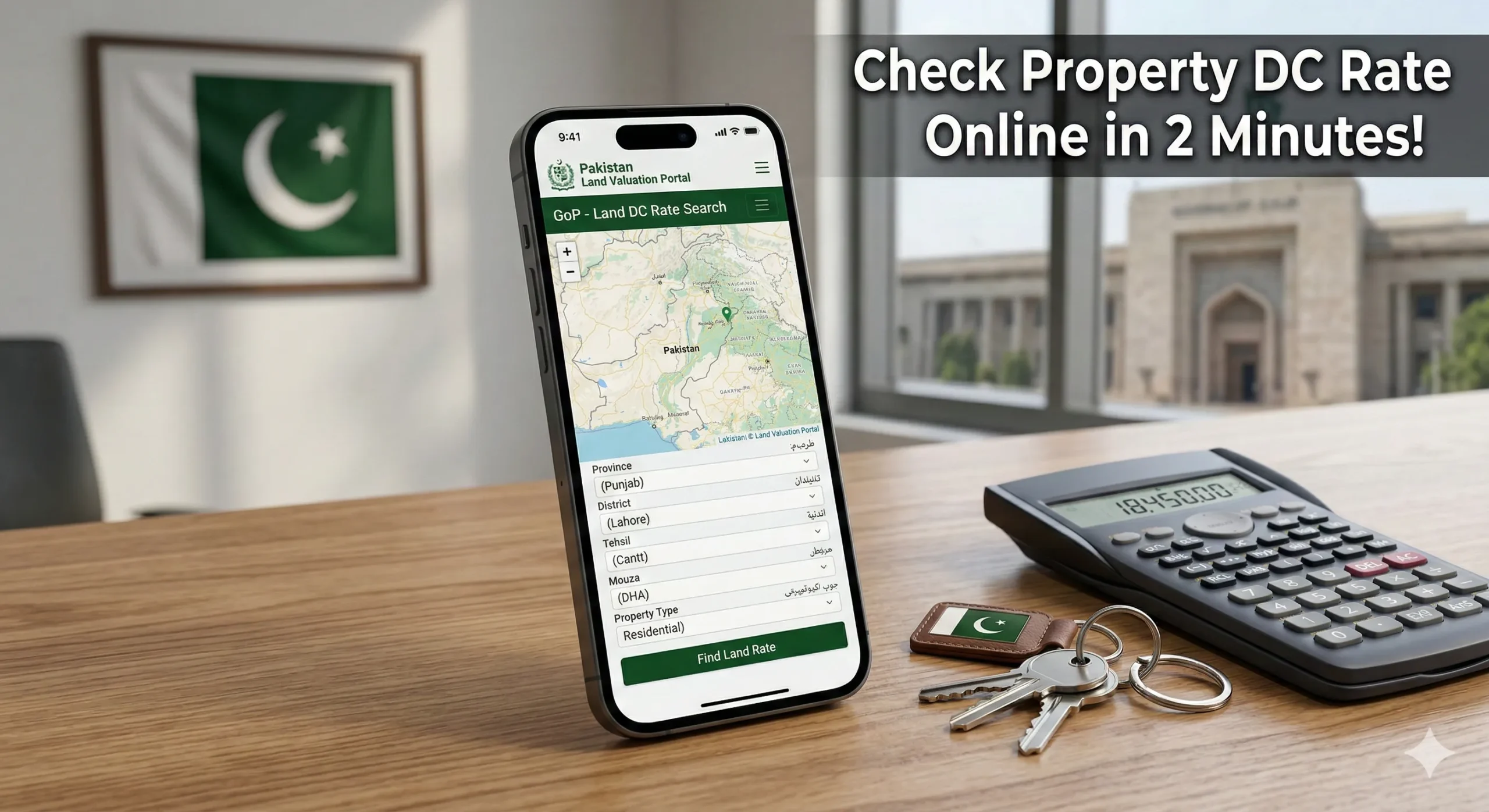
Want to know the official value of your property? Follow our step-by-step guide to check DC rates online for residential, commercial, and agricultural land in minutes.
How to Check DC Rate of Your Land Online: A Step-by-Step Guide
Buying or selling property in Pakistan requires a clear understanding of the DC Rate (District Collector Rate). This is the minimum price set by the government for property registration and tax assessment. Instead of visiting government offices and dealing with middlemen, you can now verify these rates from the comfort of your home.
Here is the most simplified way to check the DC rate of your land online.
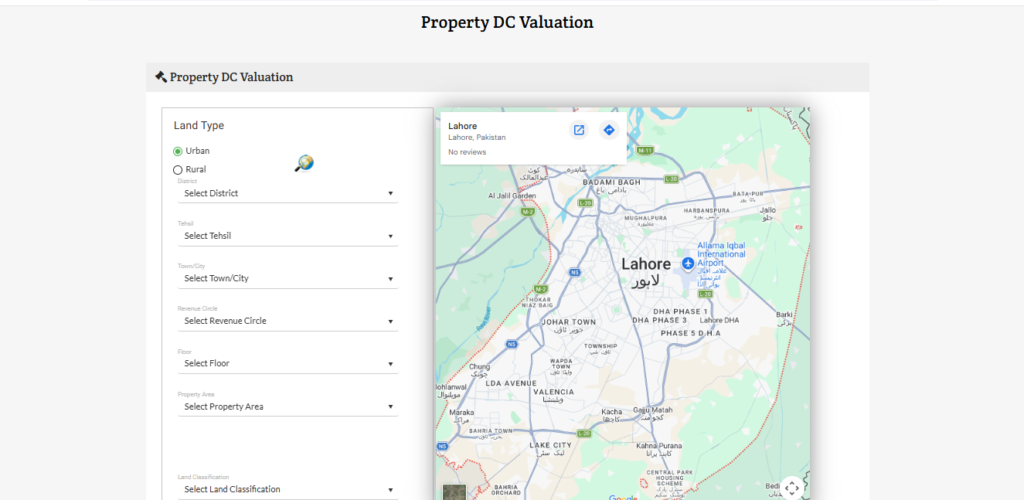
Step 1: Determine Your Property Category (Urban vs. Rural)
Before you begin the online search, you must identify the legal status of your land.

- Urban (شہری): Property located within city municipal limits.
- Rural (دیہاتی): Property located in village areas or outside defined city boundaries.
This distinction is crucial because the valuation systems and tax percentages differ significantly between the two.
Step 2: Select Your Location (District, Tehsil, and Mouza)
Once you access the official Revenue Department portal (such as the e-Stamping portal in Punjab), you will need to filter your search by:
- District: The major city/region (e.g., Lahore, Rawalpindi, Faisalabad).
- Tehsil: The specific administrative sub-division.
- Mouza: The specific revenue estate or village name where the land is registered.
Step 3: Identify Property Status (Plot vs. Built-up House)
The DC rate varies based on whether the land is vacant or developed.

- Unconstructed: Select this if you are checking the rate for a vacant plot.
- Ground Floor: Select this if there is a constructed house or building on the land.
Step 4: Choose the Nature of Land
The government categorizes land based on its usage. You must select the correct category to get an accurate valuation:
- Commercial: Shops, plazas, or high-traffic business areas.
- Residential: Plots or houses intended for living.
- Agricultural: Farmland or cultivation areas.
Expert Tip: In certain high-density areas, you may also be required to enter the Khasra Number (a specific identification number given to a plot in the land records) to get the exact location-based rate.

Step 5: Enter the Area and Calculate
The final step is to enter the total Area of your property. Ensure you select the correct unit (Marla, Kanal, or Square Feet). Once entered, click on “Find Land Rate.”
The system will instantly generate the current DC rate per unit and the total valuation of your property, which serves as the basis for your stamp duty and registration fees.
Why is the DC Rate Important?
- Legal Documentation: It determines the value of the Stamp Paper required for the sale deed.
- Tax Transparency: It helps you calculate the exact government taxes (Gain Tax, Advance Tax) without overpaying.
- Fraud Prevention: By knowing the official rate, you can avoid being misled by unauthorized dealers.
1. What is the difference between DC Rate and FBR Rate?
The DC Rate (District Collector Rate) is set by the provincial government and is primarily used to calculate Stamp Duty and Registration Fees. The FBR Rate is determined by the Federal Board of Revenue and is used to calculate federal taxes like Withholding Tax and Capital Gains Tax (CGT). Usually, FBR rates are slightly higher than DC rates but still lower than the actual market price.
To better understand how property valuation works in Pakistan, it is essential to distinguish between these two benchmarks. Here is a quick comparison:
| Feature | DC Rate (District Collector) | FBR Rate (Federal Board of Revenue) |
| Authority | Provincial Revenue Department | Federal Board of Revenue |
| Primary Use | Calculating Stamp Duty & Registration Fees | Calculating Withholding Tax & Capital Gain Tax |
| Valuation Level | Usually the lowest legal value | Higher than DC rate, closer to market value |
| Applicability | Used for local/provincial documentation | Used for federal tax compliance & “White Money” |
| Revision Cycle | Annually (typically July 1st) | Periodically (updated via FBR notifications) |
2. Is the DC Rate updated every year?
Yes, the government typically revises DC rates annually, usually at the start of the new fiscal year (July). However, special notifications can be issued mid-year if there are significant changes in the real estate market or tax policies.
3. Can I pay taxes based on a price lower than the DC Rate?
No. The DC rate is the legal minimum valuation. Even if you purchase a property for less than the DC rate, you are legally required to pay taxes and registration fees based on the official DC valuation. Reporting a lower value can lead to legal penalties and issues during the property transfer (mutation) process.
4. Why is the DC Rate much lower than the actual market price?
Historically, DC rates were kept low to keep property transactions affordable for the general public. While the government is gradually increasing these rates to bridge the gap with market values, a significant difference still exists in most areas of Pakistan.
5. What should I do if my “Mouza” or “Area” is not listed online?
If you cannot find your specific location on the e-Stamping portal, it might be because the records for that area are not yet fully digitized. In such cases, you should visit the local Tehsil Office or consult a registered Patwari to obtain the manual valuation table for that specific region.
6. Do DC rates apply to inherited property?
While inheritance transfers (Wirasat) have different tax structures, the DC rate is still used as a benchmark to determine the value of the estate for legal documentation and any future sale transactions.