Want to know if you’re eligible for a loan? Learn how to check your credit history and score in Pakistan using the Tasdeeq app and State Bank’s e-CIB system. Follow our simple 2026 step-by-step guide.
Checking your credit history in Pakistan has never been easier, thanks to digital advancements in 2026. Whether you’re applying for a car loan, a home mortgage, or a new credit card, knowing your credit score is the first step toward financial freedom.
Below is a complete, step-by-step guide to checking your credit history using the Tasdeeq App and understanding the e-CIB system.
Introduction: Why Your Credit History Matters
In Pakistan’s modern financial landscape, your Credit Information Report (CIR) is your financial identity. Banks use this report to see if you pay your bills on time. A “clean” report means quick loan approvals and lower interest rates, while a “negative” report can lead to instant rejections.

The Two Main Systems in Pakistan
- e-CIB (Electronic Credit Information Bureau): Managed by the State Bank of Pakistan (SBP). It is the master database used by banks.
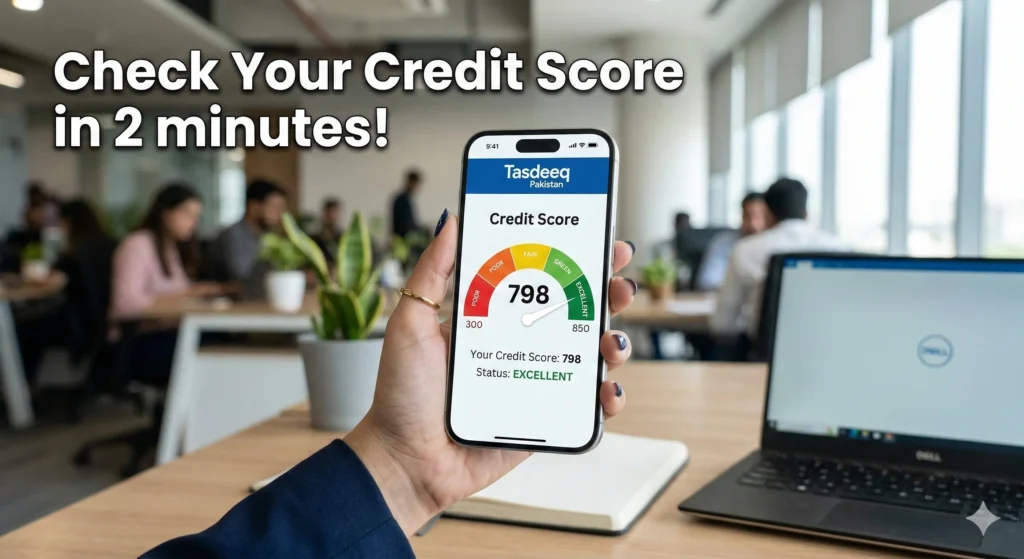
- Tasdeeq (Private Credit Bureau): The most popular SBP-licensed app that allows individuals to see their own scores instantly on a smartphone.
Step-by-Step: How to Check Your History via Tasdeeq App
The Tasdeeq app is the fastest way for a common citizen to access their credit data.
- Download the App: Search for “Tasdeeq” on the Google Play Store or Apple App Store.
- Registration: Enter your CNIC number, mobile number (registered in your name), and email.
- Identity Verification: You will undergo a quick digital KYC (Know Your Customer) process to ensure it’s really you.
- Choose Your Report:
- Basic Report: Often gives a summary of active/closed accounts.
- Full CIR (Credit Information Report): Provides a detailed 5-year history and your numerical Credit Score.
- Payment: Pay the small processing fee (usually via EasyPaisa, JazzCash, or Credit/Debit card).
- Instant Access: Your report will be generated as a PDF that you can view or download.
Want to check BISP payment status and eligibility ? Check this article https://nsct.pk/bisp-8171-phase-2-district-list-2026-announced-check-rs-13500-payment-status-eligibility/
Comparison: e-CIB vs. Tasdeeq
| Feature | e-CIB (SBP) | Tasdeeq App |
| Primary User | Banks and Lenders | Individuals/Consumers |
| Accessibility | Via Banks/Hard to get directly | Easy Mobile App |
| Credit Score | Not always shown to users | Provides a 3-digit score |
| Update Cycle | Monthly | Real-time sync with SBP data |
What is a “Good” Credit Score in Pakistan?
While every bureau has its own scale, generally:

- 750 – 850: Excellent (Easy loan approvals)
- 650 – 749: Good (Reliable borrower)
- 500 – 649: Average (May face some hurdles)
- Below 500: Poor (High risk of rejection)
Pro Tip: If you see an error in your report (e.g., a loan you already paid is still showing as “Overdue”), you must contact your bank immediately to update the record in the e-CIB system.
How a Low e-CIB Score Affects
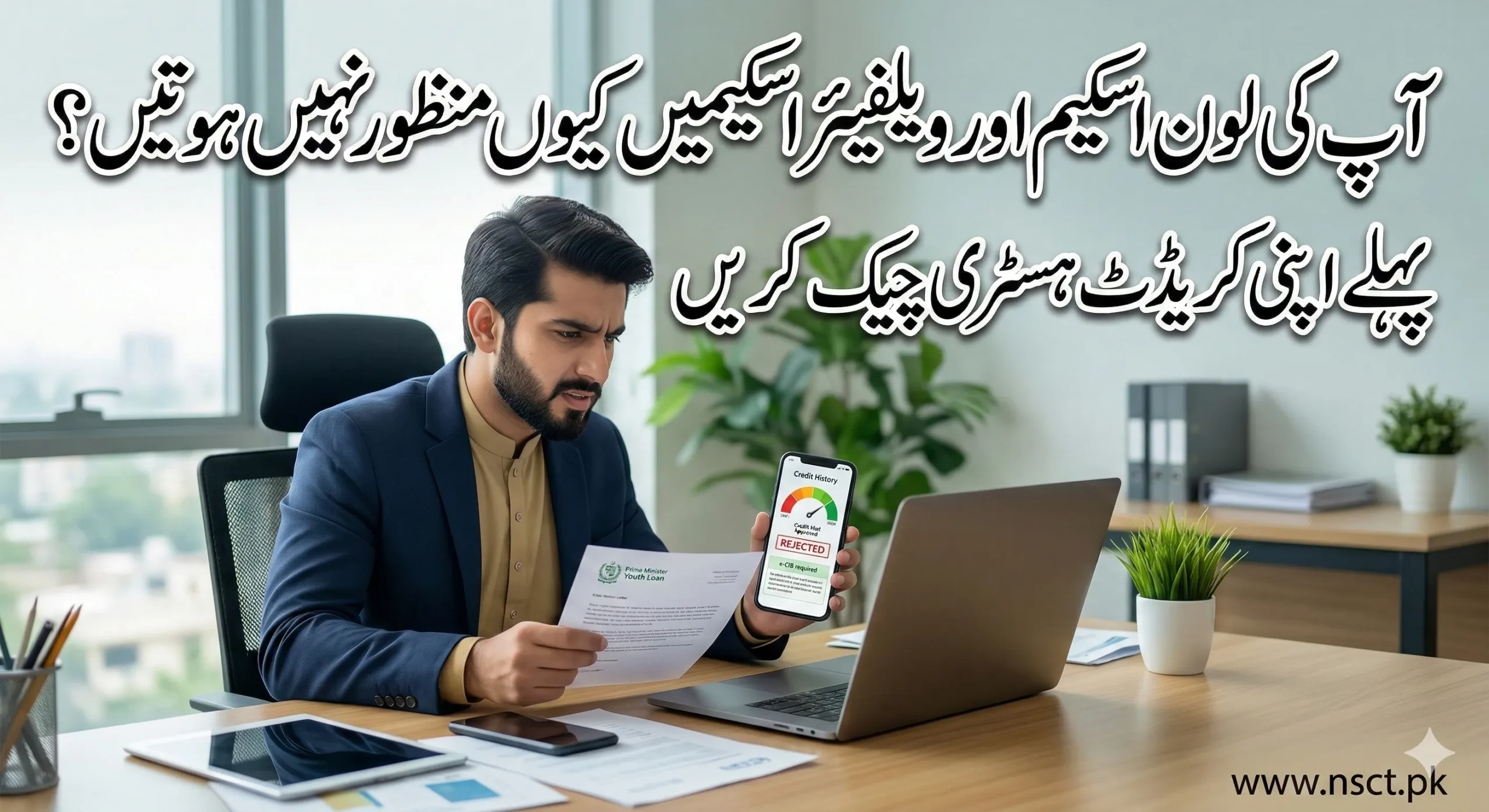
A low e-CIB (Electronic Credit Information Bureau) score can be a significant roadblock when applying for Government of Pakistan schemes, particularly those involving interest-free loans or subsidized financing.

Since most government loan initiatives are disbursed through commercial or microfinance banks, they are legally required by the State Bank of Pakistan (SBP) to check your credit history.
1. Impact on Government Loan Schemes
For programs like the Prime Minister’s Youth Business & Agriculture Loan Scheme (PMYB&ALS) or the Punjab Rozgar Scheme, a clean e-CIB is usually a “Hard Requirement.”
- Automatic Rejection: Most online portals for these schemes (like the PM Youth Portal) have a built-in check. If your CNIC is flagged for a “Write-off” or “Overdue” in the SBP database, your application may be rejected at the initial screening stage.
- Tier-Specific Barriers: * Tier 1 (Small Loans): Even for “Clean” loans (no collateral), banks still check e-CIB to ensure you aren’t a habitual defaulter.
- Tier 2 & 3 (Large Loans): Higher loan amounts require even stricter credit scrutiny. A low score indicates high risk, leading to an immediate “No” from the bank’s credit committee.
- The “Guarantor” Problem: In schemes where a third-party guarantee is required (like Punjab Rozgar), if your guarantor has a low e-CIB score, your application will be rejected even if your record is clean.
2. Impact on Social Welfare Schemes (BISP/Ehsaas)
It is important to distinguish between Loan Schemes and Welfare Schemes.
- BISP / Ehsaas Kafaalat: These programs typically do not check your e-CIB score. Eligibility for these is based on your PMT (Proxy Means Test) score, which measures your poverty level through assets, house type, and family size, rather than your bank loan history.
- Health Cards (Sehat Sahulat): These are generally provided based on NADRA data and poverty status; your credit score does not affect your right to medical treatment under these cards.
3. Key “Red Flags” in e-CIB for Govt Schemes
Banks looking at your government application specifically watch out for these three status markers:
- Overdue: You have an active balance that you haven’t paid.
- Write-off: You didn’t pay a loan, and the bank eventually gave up and “wrote it off.” This is the most damaging status.
- Settled (with loss): You paid back less than what you owed through a compromise. This can still lead to rejection in many government programs for up to 2 years.
Glossary: Key Credit Terms You Must Know
When you download your Credit Information Report (CIR) from Tasdeeq or view your e-CIB data, you will see specific financial terms. Understanding these is the difference between getting a loan approved or rejected.
- Principal Amount: The original amount of money you borrowed from the bank, not including interest or late fees.
- Overdue: This status appears if you have missed your payment due date. Even being 1 day late can technically show as “Overdue” on your monthly report.
- Default: This is a serious red flag. It means you have failed to repay your loan for a long period (usually 90 days or more). Most government schemes will immediately reject a “Defaulter.”
- Write-off: This happens when a bank loses hope of recovering the money from you and removes the loan from its active books. This is the worst status to have and will stay on your record for years.
- Settled: This means you didn’t pay the full amount, but you reached a “deal” with the bank to pay a smaller portion to close the account. While better than a “Write-off,” many banks still view this as a negative sign.
- NOC (No Objection Certificate): A formal letter issued by a bank stating that you have paid back your loan in full. Always keep this safe; you may need it to prove your creditworthiness to another bank.
- Clean Record: This means you have paid every installment on time. A “Clean” e-CIB is your golden ticket to government business loans and low-interest car financing.
How to Use This Information
- Check Regularly: Download the Tasdeeq app and check your score at least once every 6 months.
- Report Errors: If you see a “Default” for a loan you already paid, use your NOC to contest it.
- Pay on Time: Even a small credit card payment missed by a few days can drop your score
How to Fix Your Status for Govt Schemes
If you have a low score or a default history, you cannot “delete” it, but you can improve it:
- Clear All Overdues: Pay off any pending credit card bills or small loans immediately.
- Get a “Clearance Certificate”: Once paid, ensure the bank issues a No Objection Certificate (NOC) and updates the SBP database.
- The 2-Year Rule: For consumer loans, negative history stays on your e-CIB for 2 years after the date of settlement. You may need to wait this period before becoming eligible for top-tier government business loans.
FAQs: Everything You Need to Know About Credit History in Pakistan
Q1: Does checking my own credit score on the Tasdeeq app lower my score? No.
When you check your own score, it is considered a “Soft Inquiry.” Unlike a “Hard Inquiry” (when a bank checks your score because you applied for a loan), soft inquiries do not affect your credit rating at all.
Q2: How long does a “Default” stay on my e-CIB report?
In Pakistan, for consumer loans (like personal loans, credit cards, or auto loans), a negative record usually stays on your e-CIB for two years after you have fully settled the debt. For business loans, the history can be visible for a longer period.
Q3: Can I get a Government Loan if I have a “Settled” status on my report?
It depends on the specific scheme. Some government programs allow “Settled” cases if the settlement happened more than a year ago. However, most top-tier schemes (like the PM Youth Loan) prefer applicants with a “Clean” history (no defaults or settlements at all).
Q4: My loan is paid, but the e-CIB still shows “Overdue.” What should I do? This is a common reporting error. You should:
- Contact the bank that issued the loan.
- Provide your NOC (No Objection Certificate) or final payment receipt.
- Request them to update your status in the State Bank’s e-CIB database. This usually takes 15 to 30 days to reflect.
Q5: Is there any way to “delete” bad credit history? No.
No person or agency can legally “delete” a genuine record from the State Bank’s e-CIB. If anyone claims they can do this for a fee, it is a scam. The only way to fix your history is to pay your debts and wait for the reporting period to clear.
Q6: Do BISP or Ehsaas payments depend on my credit score?
No. Welfare programs like BISP and Ehsaas are based on poverty surveys (NSER) and your PMT score. They do not look at your bank credit history or e-CIB report to determine eligibility for monthly stipends.
Q7: Can a student check their credit score?
Yes, as long as you have a valid CNIC. However, if you have never taken a loan, a credit card, or a postpaid mobile connection, the app may show “No History Found.” This isn’t bad—it just means you haven’t started your “credit journey” yet.
Q8: What is the fee for checking a report on Tasdeeq?
The fee varies based on the type of report (Basic vs. Detailed CIR), but it generally ranges from Rs. 300 to Rs. 800. It is a small investment to ensure your financial identity is protected.
Final Verdict
Monitoring your credit history once every six months is a healthy financial habit. Using the Tasdeeq app gives you the power to fix errors before they stop you from getting that dream car or home.