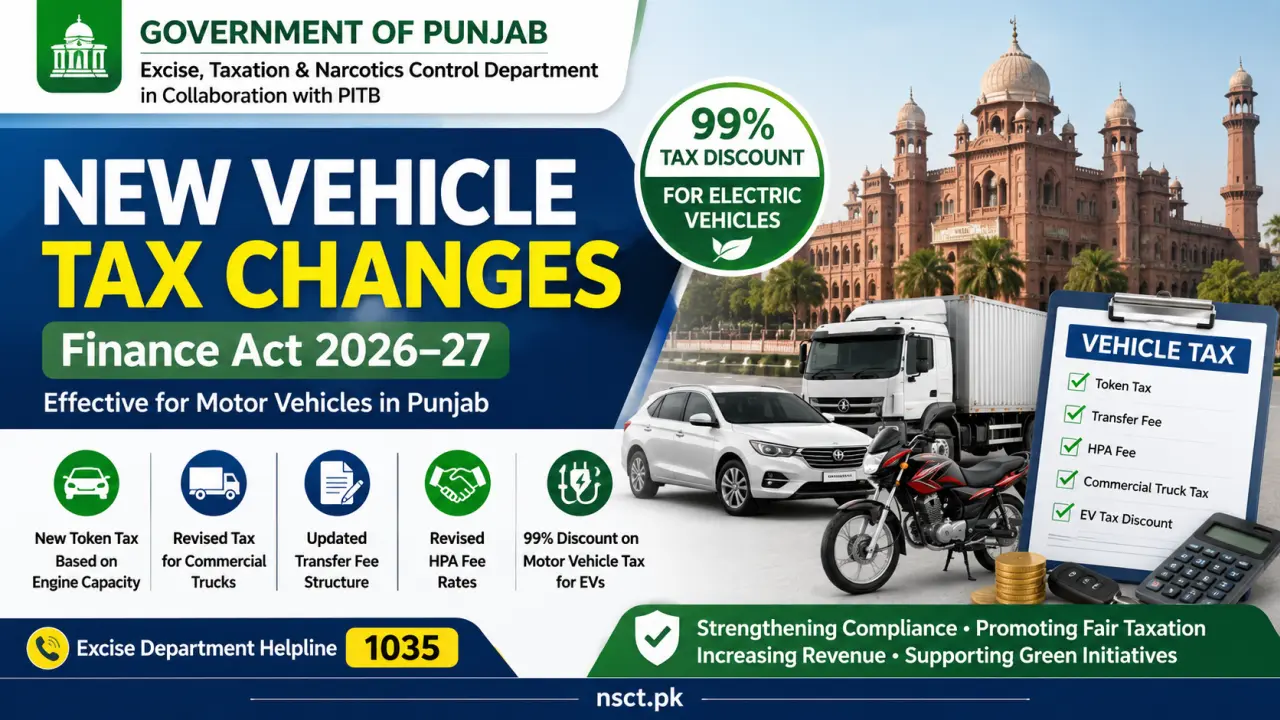
The Government of Punjab has introduced important changes to motor vehicle taxes through the Finance Act 2026–27. These amendments have been announced by the Excise, Taxation & Narcotics Control Department in collaboration with PITB. The revised tax structure affects private cars, commercial trucks, vehicle transfer fees, Hire Purchase Agreement (HPA) charges, and electric vehicles.
These updates are designed to improve tax compliance, create a fairer taxation system, increase government revenue, and encourage environmentally friendly transportation by offering major tax relief for electric vehicles.
Whether you own a bike, car, commercial truck, or an electric vehicle, understanding these new rules can help you estimate your future costs and avoid surprises during registration, transfer, or annual tax payments.
Finance Act 2026–27 at a Glance
| Category | New Change |
|---|---|
| Private Car Token Tax | 0.3% (1001–2000cc), 0.4% (2001cc and above) |
| Commercial Truck Token Tax | New annual tax slabs introduced |
| Vehicle Transfer Fee | Revised for bikes, cars and HTVs |
| HPA Fee | Updated for selected vehicle categories |
| Electric Vehicles | 99% discount on annual Motor Vehicle Tax |
| Helpline | 1035 |
Why Has Punjab Introduced These Tax Changes?
The provincial government says these reforms are intended to modernize vehicle taxation while ensuring fairness across different vehicle categories.

The key objectives include:
- Improving tax compliance
- Making taxation more equitable
- Increasing provincial revenue
- Supporting environmentally friendly transportation
- Encouraging the adoption of electric vehicles
By linking taxes to engine capacity and offering incentives for cleaner transportation, Punjab aims to balance revenue generation with sustainable development.
New Private Car Token Tax Rates
One of the biggest changes under the Finance Act 2026–27 is the revised token tax for private vehicles.

Instead of fixed taxation, the revised rates are now based on engine capacity.
New Token Tax Structure
| Engine Capacity | Annual Token Tax |
|---|---|
| 1001cc–2000cc | 0.3% |
| 2001cc and Above | 0.4% |
This means owners of larger engine vehicles may pay a higher annual token tax compared to smaller vehicles.

The revised structure is intended to make taxation proportional to vehicle size and value.
Commercial Truck Token Tax Revised
Commercial transport vehicles also fall under the revised taxation framework.
The Finance Act introduces new annual token tax slabs for trucks.
Revised Commercial Truck Tax
| Annual Token Tax |
|---|
| Rs. 500 |
| Rs. 1,000 |
| Rs. 6,600 |
| Rs. 12,000 |
| Rs. 18,000 |
| Rs. 24,000 |
The applicable amount depends on the truck category and specifications as determined by the Excise Department.
Commercial fleet owners should verify the applicable tax slab before renewing vehicle documents.
New Vehicle Transfer Fee Structure
Anyone transferring ownership of a vehicle must now pay revised transfer charges according to vehicle type.
Updated Transfer Fee Table
| Vehicle Category | Transfer Fee |
|---|---|
| Bike | Rs. 910 |
| HTV | Rs. 9,075 |
| Other Vehicles up to 1000cc | Rs. 4,540 |
| Other Vehicles 1001–1800cc | Rs. 9,075 |
| Other Vehicles Above 1800cc | Rs. 18,150 |
Vehicle buyers should consider these revised charges while calculating the total cost of ownership.
Updated HPA (Hire Purchase Agreement) Fee
The Finance Act also revises fees related to Hire Purchase Agreements.
New HPA Charges
| Vehicle Category | HPA Fee |
|---|---|
| Bike | No Change |
| Vehicles up to 1000cc | No Change |
| HTV | Rs. 9,075 |
| Vehicles 1001–1800cc | Rs. 9,075 |
| Vehicles Above 1800cc | Rs. 18,150 |
Owners financing vehicles through hire purchase arrangements should review these revised fees before completing documentation.
Major Relief for Electric Vehicle Owners
One of the most significant announcements in the Finance Act 2026–27 is the incentive for electric vehicles.
99% Discount on Annual Motor Vehicle Tax
Electric vehicle owners will receive:
99% discount on Motor Vehicle Tax (MVT).
This is one of the largest tax incentives introduced to encourage the adoption of clean transportation in Punjab.
Lower annual taxes can make EV ownership more attractive for individuals and businesses looking to reduce operating costs.
Who Will Be Affected?
The revised tax policy impacts different groups in different ways.
Private Car Owners
Owners of vehicles above 1000cc should review the revised token tax applicable to their engine capacity.
Bike Owners
Bike transfer fees remain relatively low at Rs. 910, while HPA fees remain unchanged for motorcycles.
Commercial Transport Operators
Truck owners and logistics companies should check the updated annual token tax category before renewal.
Electric Vehicle Owners
EV users are likely to benefit the most due to the 99% reduction in annual Motor Vehicle Tax.
Practical Impact of the New Tax Structure
The Finance Act introduces both higher charges in certain areas and incentives in others.
For example:
- Larger engine vehicles may incur higher annual token taxes.
- Vehicle ownership transfers now carry revised administrative costs.
- Electric vehicles become significantly more affordable to maintain due to reduced taxation.
- Commercial vehicle operators should account for revised annual token tax rates in operational budgets.
These reforms encourage cleaner transportation while aligning tax collection with vehicle categories.
Benefits of the Finance Act 2026–27 Tax Reforms
The revised taxation framework offers several expected benefits.
- Better compliance with vehicle taxation laws
- Transparent fee structure
- Encouragement for EV adoption
- Sustainable transportation policies
- Improved provincial revenue collection
- Simplified tax categories
How Vehicle Owners Can Prepare
Vehicle owners should take a few simple steps before renewing registration or transferring ownership.
- Confirm your vehicle’s engine capacity.
- Check the applicable token tax category.
- Review transfer charges before buying or selling a vehicle.
- Verify HPA fees if purchasing through financing.
- Consider electric vehicles if planning to purchase a new vehicle.
Being informed helps avoid delays during documentation and tax payments.
Helpline for Assistance
If you need clarification regarding the revised tax structure, transfer fees, or vehicle-related taxes, you can contact the official Excise Department Helpline.
Excise Department Helpline: 1035
Frequently Asked Questions (FAQs)
What is the new token tax for private cars in Punjab?
Private vehicles with engine capacities between 1001cc and 2000cc are taxed at 0.3%, while vehicles above 2000cc are taxed at 0.4%.
Has the bike transfer fee changed?
Yes. The revised transfer fee for motorcycles is Rs. 910.
What is the transfer fee for cars above 1800cc?
The updated transfer fee is Rs. 18,150.
Are HPA fees changing for motorcycles?
No. HPA charges remain unchanged for bikes and vehicles up to 1000cc.
What is the benefit for electric vehicle owners?
Electric vehicles receive a 99% discount on annual Motor Vehicle Tax.
Why has Punjab revised vehicle taxes?
The reforms aim to strengthen compliance, improve fairness, increase revenue, and support environmentally friendly transportation.
Are commercial trucks included in these changes?
Yes. Commercial trucks now follow revised annual token tax slabs.
Who announced these tax reforms?
The changes were announced by the Excise, Taxation & Narcotics Control Department in collaboration with PITB.
Where can I get official information?
Vehicle owners can contact the Excise Department Helpline at 1035 for assistance.
Do these changes apply only in Punjab?
The announced changes relate to the Government of Punjab’s Finance Act 2026–27.
Visual Content Suggestions
- Infographic showing old vs. new vehicle tax structure
- Comparison table for transfer fees
- Engine capacity-based token tax chart
- Timeline of Finance Act 2026–27 implementation
- Electric vehicle tax savings illustration
- Flowchart explaining vehicle transfer charges
Conclusion
The Finance Act 2026–27 introduces significant updates to Punjab’s vehicle taxation system. The revised token tax for private cars, updated transfer fees, new commercial truck tax slabs, and HPA charges reshape how vehicle owners calculate their annual expenses. At the same time, the government has taken a strong step toward cleaner transportation by offering a 99% discount on Motor Vehicle Tax for electric vehicles.
Whether you are renewing your vehicle registration, purchasing a used car, financing a vehicle, or considering an EV, understanding these changes can help you make informed financial decisions. Before completing any vehicle-related transaction, check the applicable tax category and fee to avoid unexpected costs.